Xin Yi Wu by Wang Wei (699-761)
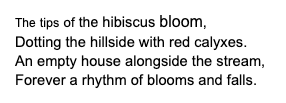
The following analysis owes a lot to Zhao GuangXu’s Translating the Iconicity of Classical Chinese Poetry:
The first line of this classical Chinese poem by Wang Wei reads 木末芙蓉花. Now even if you can’t read these characters, I want you to look closely at them. What’s happening? Well according to François Cheng, this line is simulating the blooming of a flower. How?
The first character 木 (branch or wood) is a fairly simple character with only four strokes. The next, 末 (end) has five. The next 芙 (which in combination with the next two characters means “hibiscus”) has seven strokes. The line itself is blossoming, just like the hibiscus in the poem. Now in actuality, the word for bloom (發紅) doesn’t actually appear until the second line (after the comma) but the reader already has the image of blooming in the first.
Many translations struggle to preserve the iconicity of the original–and with good reason. How does one in English convey what is being conveyed pictorially in Chinese? Like most translation questions, there isn’t any one good answer, but perhaps using one of English’s few pictorial elements (font size) is one feasible approach.
Also, as a note, I didn’t know what a calyx was until reading this poem, and I searched far and wide for a more everyday option for the word but was unsuccessful. Any botanists reading this who might know one please hit my line.